
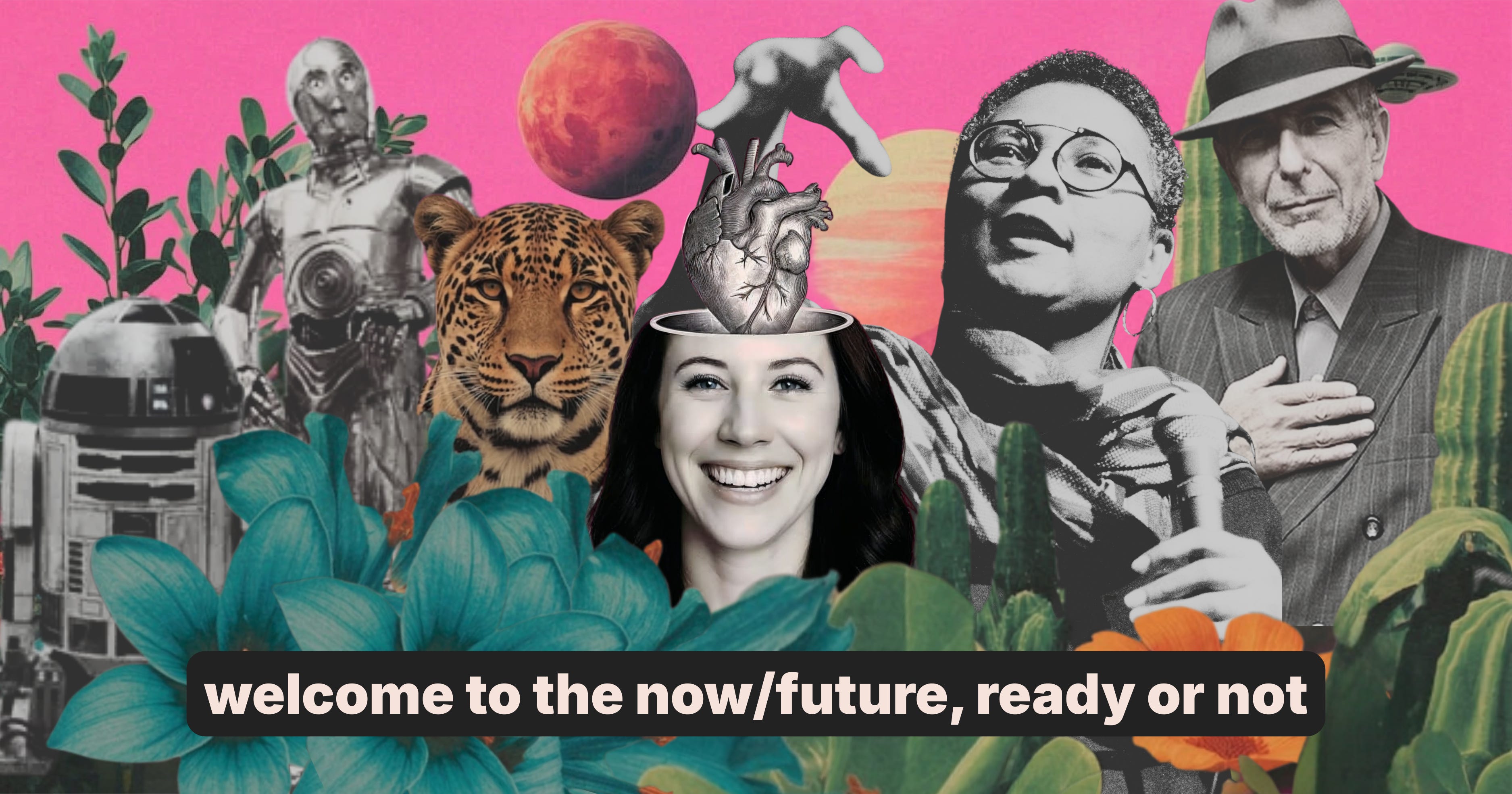
“The future is already here — it’s just not evenly distributed.”
Science fiction writer William Gibson told us that in the ‘90s. And that’s exactly the terrain this (em-dash-positive) publication explores.
Culture OS
The cultural operating system that organized the last few centuries of life in the West is breaking down in real time. The version of the good life many of us were promised — work hard, go to school, climb the ladder, buy the things, have the kids, trust the institutions — is more myth than reality.
The social contract has disintegrated. Our lives feel increasingly hard to inhabit. At least for most of us, this shit is quite obviously not working. The systems theoretically meant to enable our thriving are functioning more like a noose around our necks1.
You can feel it even if you can’t quite name it yet. That eerie, creeping sense that something is very, very wrong. That’s because it is. Many somethings. You’re not imagining it. We are actually living in increasingly dystopian conditions.
The messier truth of this moment is that something else is happening, too. It’s as if there are two timelines running in parallel. On one track, we’re speed-running what the economist Yanis Varoufakis calls technofeudalism. On the other, we’re reorganizing around what matters most: wellbeing, connection, care, kindness. The monoculture is fracturing back into polyculture. Small is becoming beautiful again. Relational economics are attempting their return. We’re increasingly post-hustle, antiwork and prosocial.
Those better possible futures aren’t utopian and they aren’t waiting somewhere out ahead of us either. They’re already here, just unevenly distributed, just as Gibson foretold.
Wtf is f*ck i love you?
f*ck i love you is my contribution to that second track; to getting from here to futures worth living in.
It’s part cultural analysis, part memoir, part applied strategy, part prefigurative politic. It’s many things at once because this moment — much like my own nonlinear brain — does not fit neatly into discrete, disciplinary boxes. Whether I’m writing about my own mental health or AI or neurodivergence or economics or all of them at the same time, I’m always circling one big idea.
I call it The New Good Life.
It’s the second timeline. It’s the future worth living in. It’s the better version of the (old) good life we were promised, manifestos not required. It’s shorthand for the growing constellation of ever-louder signals2 that more relational, human, dignified alternatives to the technofeudal descent are possible, identifiable and ours to create.
f*ck i love you — FILY for short — is where I’m trying to write and live that story into existence. And it’s my invitation to you to join me and the millions, if not billions of us, trying to realize their version of it, too.
What’s love got to do with it?
F*ck, I love you — and its first cousin I f*cking love you — is what I actually say in real life when something lights up my brain and my heart at the same time. It’s joy, recognition, delight and reverence all smashed together and spontaneously exclaimed.
It’s also my thesis in four words.
bell hooks taught me that love is a verb. Not a thing you feel — a thing you do. A practice, an ethic, a political choice. Reciprocity in action. An operating system entire societies can run on. The basic pattern required for all human flourishing.
And if the old good life runs on extraction, domination, and transaction, the new one will have to run on something else.
My bet is that something looks a lot like love.
What you’ll find where
To get practical for a minute, here’s what you’ll find where in the FILY universe:
The main feed
Long form essays and audio, usually using my experience as a fractal of collective experience. Self-and-systems at the same time. Memoir as cultural exposition.
Subscribe if you love personal revealings that can’t help but find themselves tangled up in wry, irreverent social commentary coloured by just enough profanity
futures worth living in
The practical, applied stuff. Foresight analysis. Frameworks. Tools. Guides. Models. How tos. IRL experiences.
Subscribe if you want maps for getting from here to there.
f*ck i loved that
A short-form, ai-assisted podcast experiment. A weekly-ish synthesis of content that made me say, f*ck i loved that. An nsfw, highlight reel, tl;dr of what I’ve paid attention to recently so you don’t have to.
Subscribe if this subscriber’s review sounds valuable to you, too: “You’re pre-digesting things for me in a world I can’t keep up with, this has so much value.”
divergent futures
All of my thinking and learning about neurodivergence, aka neurocomplexity. If the old good life was a cognitive monoculture, the new good life is a cognitive polyculture with consequences for us all. Especially relevant for late-diagnosed, high-masking humans and the people who love and work with them.
Subscribe if you’re a zebra who’s tired of pretending to be a horse — or if you love one. Or if you just want to know wtf that means.
FILY is also choose your own adventure: I offer voiceover on all my posts, usually by me, sometimes Substack’s robo-voice.
About Jenn
During a pretty spectacular and quite public dissolution of my mind in 2024, I started calling myself a “futures doula.” When I landed both feet back in reality, I scrubbed all evidence of its utterance from existence.
A futures doula? Come on.
ALL CAPS, HEAT-CREEPING-UP-MY-NECK, STOMACH-TWISTING, CRINGE.
When you’ve lost your mind in public, and your entire livelihood depends on your mind, intellectual credibility becomes important. Very important. Futures doula sounds like one of those made up, flaky, self-appointed job titles the internet ruthlessly mocks. I wasn’t going to be delivering strategy to senior leaders with a moniker like that.
Trouble is…it’s just so…accurate.
Doula comes from the ancient Greek for “a woman who serves.” A doula’s role is to support during intense, overwhelming transitional processes — typically birth, increasingly death. They advocate, comfort, and guide through the unknown.
Collectively, we are very much in the unknown. Gramsci called this time the interregnum: the old is dying and the new cannot be born; in this interregnum a great variety of morbid symptoms appear.
Appear they have.
And maybe futures doula disqualifies me from being LinkedIn-credible, but fuck it. The planet does not need any more LinkedIn-credible people. I’m pretty sure that kind of pretending is part of how we got into this mess to begin with. Cosplaying a consultant saying things like “circle back” and “strategic foresight” has cost me too much.
So here’s the thing I need to claim all the way, because be damn sure we are giving birth right now:
Hi, I’m Jenn. 👋🏼 I’m so happy you’re here.
I’m a futures doula whose practice is love, whose way is relational, whose frameworks reconnect us to ourselves and each other by sharing what I know.
And about what I know and how I know it3: By vocation and obsession, I’ve spent twenty years learning and doing at the intersection of the future of work and learning. I’m a human geographer by education, a strategist by trade, a designer in practice, an educator by lineage, a writer and dot-connector and community-builder by compulsion. My head and heart are the same entity and intellectual intimacy is my love language (iykyk). That’s at least partially explained by the fact I’m neurocomplex4 — autistic, ADHD, and navigating an autoimmune disease. It also means I feel the cost of broken systems in my body and my bank account, not just my analysis. A more relational now/future is a project I’m very much invested in.
I started this publication to write myself back into existence after my life imploded in 2024. Now it’s time to write a livelihood back into existence, too.
I hope you’ll join me.
I hope you’ll stay a while.
I think you’ll like it here.
And if you’re still here…
if any of my words lit up your brain and your heart at the same time…
well…
f*ck i love you, too.
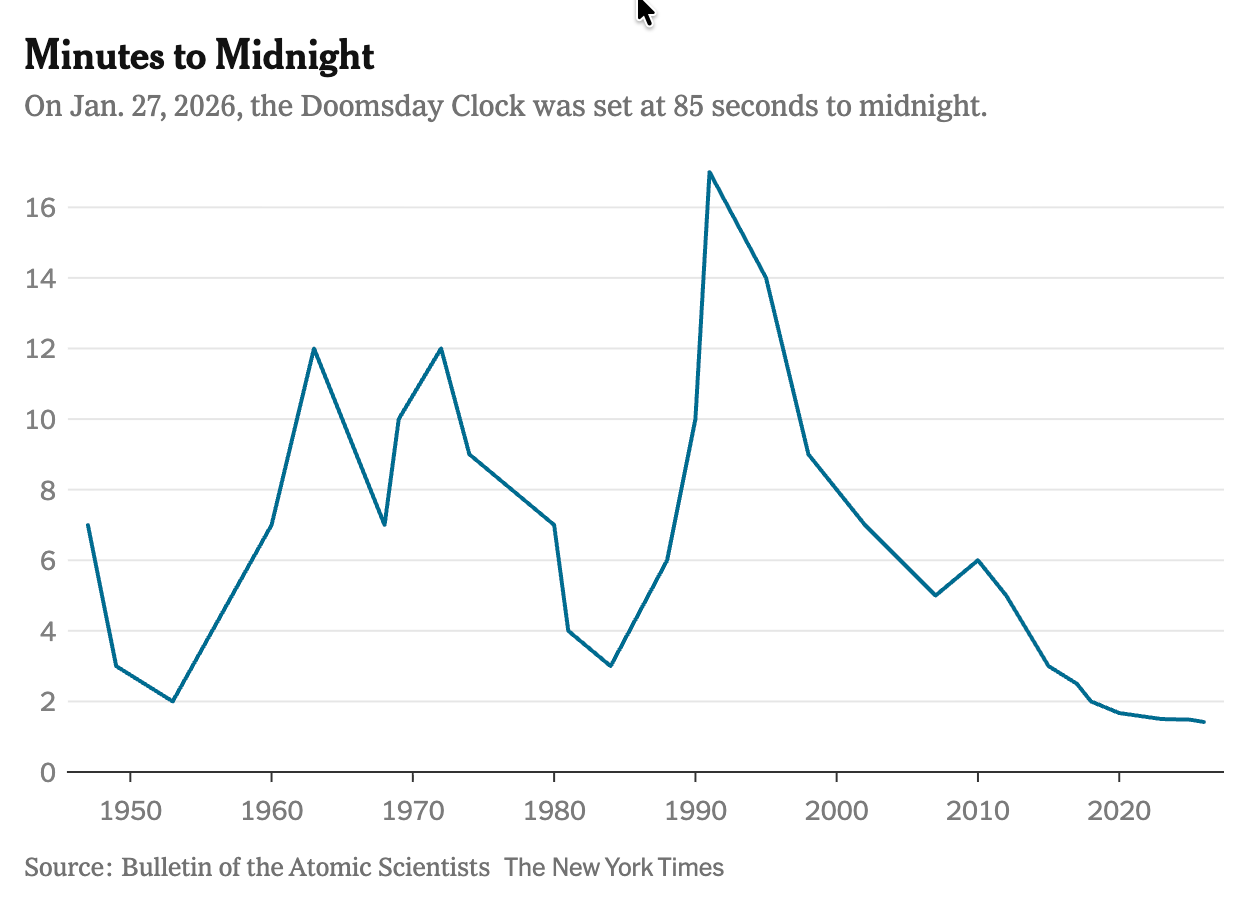
The Doomsday Clock was invented by Einstein, Oppenheimer and friends during the early atomic era to convey to the general public how close we were to annihilation without radical intervention. Today it is stewarded by a collective of scientists, many Nobel laureates. Every January the time is updated. In 2026 the clock was moved four seconds closer to midnight. It’s now 85 seconds to midnight, the closest we’ve ever been to self-annihilation by a wide margin. Even at the height of the cold war, the clock only ever made it to 2 minutes to midnight. In 2025 when they advanced the clock to 89 seconds, their joint statement was unequivocal: “the world is on a course of unprecedented risk, and that continuing on the current path is a form of madness.” Noose, indeed.
Assertions like these can sound pollyanna, I know. Mine comes from 20 years of studying complex social systems and multiple recent consulting projects documenting the evidence to inform strategy. Here is a video summary. Here is a foresight study documenting it from an investment perspective.
Credit where it is due. The specific construction of my statement, I’m a futures doula whose practice is love, whose way is relational, whose frameworks reconnect us to ourselves and each other by sharing what I know. is fellow substacker, Kelly Diels’ Surface Your Methodology formula. You can read my original reflections on this here, and Kelly’s post about it, here.
Neurocomplex is a term coined by fellow substacker Lindsey Mackereth to use in place of neurodivergent or any of the pathologized acronyms I’ve collected after my name: AuDHD, MDD, PMDD, or CPTSD — all terms used to describe the broad collection of neurological differences, sensitivities — and in DSM terms, disorders — I navigate in my daily life. And often incorporate commentary on in my writing.
I prefer neurocomplexity because it acknowledges I am a whole human and my cognition is, by default, complex and highly sensitive. It also acknowledges that stress determines whether the gifts or the challenges of this wiring shows up. These differences are not something to be pathologized, but instead important to understand so that I can understand I’m not a total fuck up. Because life gets pretty ruthless when you’re a zebra who spent ~40 years trying to be a horse.
“Why do you need a label? Because there is comfort in knowing you are a normal zebra, not a strange horse. You can’t find community with other zebras if you don’t know where you belong. It is impossible for a zebra to be happy or healthy spending its life feeling like a failed horse.”
-Unknown, from “Too Pretty to Be Autistic” by Kelly Stonelake
